
Australian Migration Newsletter - October 2026
Australia's Migration Changes: What Is Really Changing?
There has been a lot of discussion in Australia over the past few months about "cutting migration". There have also been some significant changes to Australia's visa system, particularly affecting international students, their family members, visitors and working holiday makers.
These changes are significant. But it is important to understand what part of Australia's migration system is actually being targeted.
The current focus is much more heavily concentrated on temporary migration and the pathways that allow temporary visa holders to remain in Australia for extended periods than on the permanent skilled migration program itself.
That distinction is important when trying to understand what the recent changes mean for people considering migration to Australia.
Permanent migration is only part of the picture
One of the difficulties with the current migration debate is that the term "migration" is often used as though everyone arriving in Australia is part of the permanent migration program.
They are not.
Australia has a permanent migration program, under which people are granted permanent visas such as skilled, family and humanitarian visas. The number of places available through the permanent program is largely determined by government planning levels each year.
There is also a very large temporary migration system. This includes international students, temporary skilled workers, working holiday makers, visitors and people on a range of other temporary visas.
And then there is Net Overseas Migration (NOM), the figure that has received so much attention recently.
NOM is a statistical measure of population change resulting from people moving into and out of Australia. It is not simply a count of permanent visas granted. The ABS estimates migration according to how long people stay in Australia, meaning that people on temporary visas can contribute to NOM if they meet the relevant residence criteria.
The distinction matters because the number of people entering Australia on temporary visas has become a much larger part of the migration picture.
According to an ABC analysis of the latest available migration data, around 570,000 people migrated to Australia in 2024–25. Only about 15 per cent of these arrivals were people entering on permanent visas. The majority were entering on temporary visas. ABC's analysis also shows that the number of people entering on permanent visas has been relatively stable, while temporary migration has been the part that has grown most significantly over time.
The latest ABS figures show that Net Overseas Migration was 292,100 in the year to March 2026, down from 309,500 in the previous year and well below the post-COVID peak.
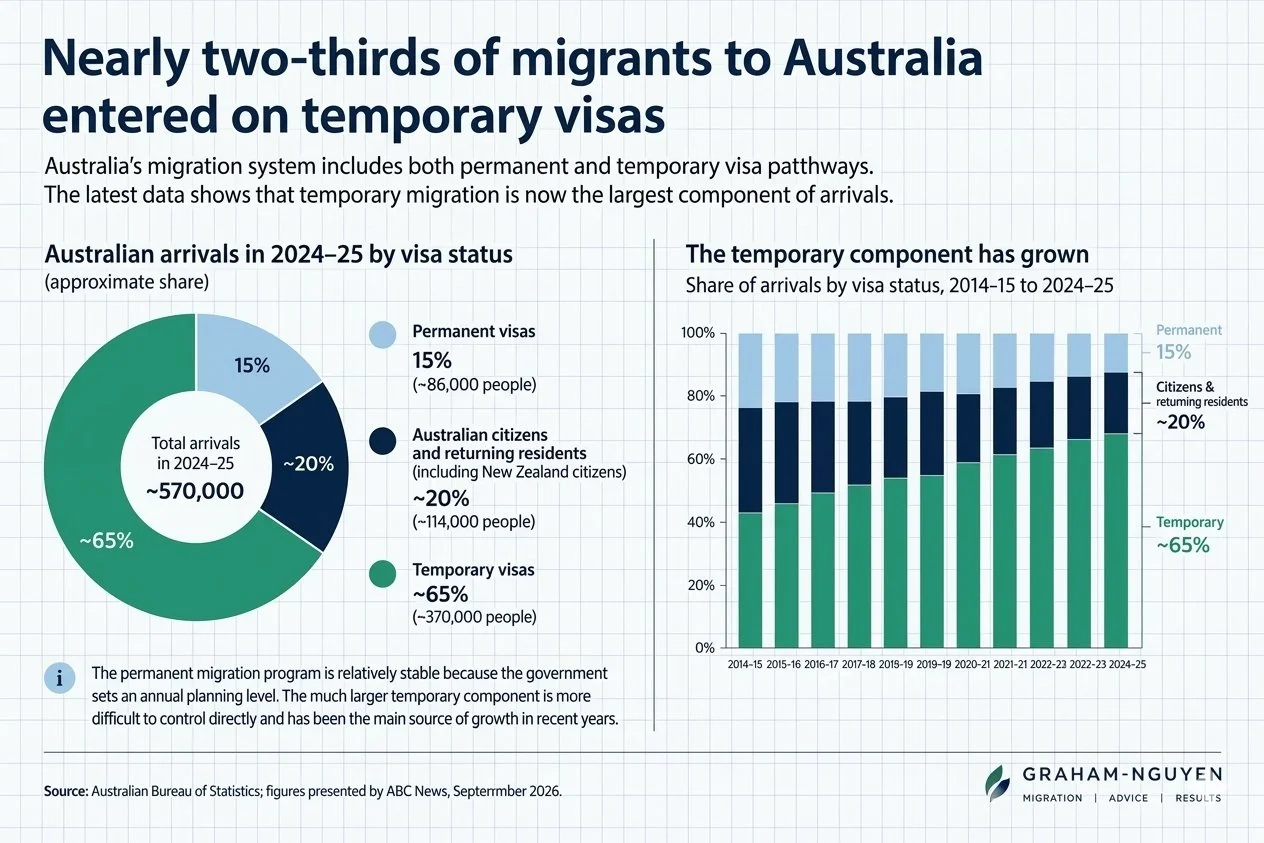
This helps explain where much of the current policy attention is going.
Why are students such a focus?
The international student program is one of Australia's largest temporary visa programs and has been an important contributor to the rapid growth in temporary migration following the COVID-19 border closures.
The government's response has not simply been to reduce the number of student visas. Instead, there has been a strong focus on the integrity of the student visa system: whether applicants are genuinely coming to study, whether courses are being used to extend a person's stay in Australia, and whether students are repeatedly moving between courses and visa pathways.
One recent example illustrates this approach. In September, the government prevented new students from commencing a particular graduate diploma after concerns that it was being used by some international students to switch courses and prolong their stay in Australia. Existing students can complete their studies, but providers can no longer recruit or commence new students in the course. The government described this as the first use of new course-cancellation powers to protect the integrity of the international education system.
The issue is broader than individual courses. Australia is also dealing with a large backlog of student visa refusals under review by the Administrative Review Tribunal (ART). In 2024–25, the ART received 32,198 study-related review applications and had 38,067 study visa cases on hand at 30 June 2025. By 30 June 2026, this had risen to 54,176 active study-visa cases, including 53,463 student visa refusal cases.
The growing number of ART cases also provides an indication of the impact of stricter student visa processing, particularly for people applying for further student visas while already in Australia. More applications are being refused, and some applicants are then seeking review rather than leaving Australia immediately. This means that increased visa refusals do not translate directly into an immediate reduction in the number of international students physically present in Australia.
Nevertheless, the increase in refusals and the resulting review caseload are part of the broader effort to reduce temporary migration and strengthen the integrity of the student visa program. Since 1 June 2026, most reviews of student visa refusals have also been decided without an oral hearing, subject to limited exceptions.
These changes therefore take time to flow through to Australia's overall migration statistics. There can be a considerable gap between a visa application being refused, a review being lodged and finalised, and the person ultimately leaving Australia.
The latest changes go beyond student visas
On 17 September, Home Affairs Minister Tony Burke announced the next stage of the government's migration reforms.
The stated objective is to reduce Net Overseas Migration to 245,000 in 2026–27 and 225,000 in 2027–28. The government's measures are aimed predominantly at temporary migration and the way temporary visa holders move through the immigration system.
Among the announced measures are:
International students and their families
The government is restricting secondary applicants on most student visas, meaning that international students will generally have much more limited ability to bring family members to Australia.
The scale is significant. In the last financial year, 337,427 student visas were granted, including 45,991 visas granted to secondary applicants classified as dependants or family members.
Visa hopping
The government is also changing the student visa system to address what it describes as "visa hopping" — moving between different temporary visas or courses in order to extend a person's stay in Australia.
This is particularly relevant where a person completes one course, obtains a temporary graduate visa, undertakes further study and then seeks another temporary pathway to remain in Australia.
Visitor visas
The government is introducing a No Further Stay condition on visitor visas. The stated purpose is to make the visitor visa a genuine temporary visitor pathway rather than a mechanism for extending a person's stay through another visa application. The new condition will apply to future visitor visas and does not change the position of people already in Australia.
Working Holiday Maker visas
The government is also changing the Working Holiday Maker program. Ballots will be introduced for people seeking second- and third-year working holiday visas, with a regional work requirement attached to those later years. The government has also said it intends to stabilise processing times for Working Holiday Maker applications at three months.
Temporary skilled migration
The government is also continuing to prioritise skilled migration in sectors facing labour shortages, including healthcare, construction, education, defence, resources and agriculture.
What does this mean for people planning to migrate?
The overall picture is more nuanced than the headlines about "cutting migration" might suggest.
Australia is not simply closing its skilled migration program.
The permanent migration program continues, and the government has specifically said it wants to retain and prioritise skilled workers in areas where Australia has identified workforce needs. At the same time, the government is tightening the much larger and more complicated temporary migration system.
That means the current changes are particularly relevant to people considering:
studying in Australia;
bringing family members while studying;
using successive student and graduate visas to remain in Australia;
extending a stay after entering as a visitor;
obtaining second or third Working Holiday Maker visas; or
remaining in Australia through repeated temporary visa applications.
For someone considering a genuine skilled migration pathway, the picture is different. As has always been the case, much of the skilled migration program continues as usual, with the government continuing to use skilled migration to address identified workforce needs. Recent changes have included measures to prioritise skilled migration in areas such as healthcare, construction and other sectors where workers are required.
The bigger picture
The Australian migration system is unusually complicated because people can move through several different temporary and permanent visa categories during their time in Australia.
Importantly, these pathways continue to exist and are used legitimately by many people, exactly as the visa system is intended. For example, a student may progress to a graduate visa, then to a skilled temporary visa and eventually to permanent residence. A temporary skilled worker may also move to permanent residence where they meet the relevant requirements.
The issue is that the system also contains pathways that can be used to prolong a person's stay without necessarily reflecting the original purpose of the visa.
This is one reason why the government is increasingly talking about who arrives, who stays and who leaves, rather than simply how many permanent visas are granted.
The current reforms are therefore best understood as an attempt to exert greater control over the temporary migration system and the pathways through it.
Some of these changes are already in effect, while others will be introduced progressively through regulations, visa conditions and ministerial directions over the coming year.
For anyone considering an Australian visa, the practical lesson is simple: the particular visa pathway matters.
The fact that Australia is tightening some temporary migration pathways does not mean that all migration pathways are being tightened in the same way. The requirements, risks and opportunities can be very different depending on whether the objective is to visit, study, work temporarily or pursue permanent residence.
